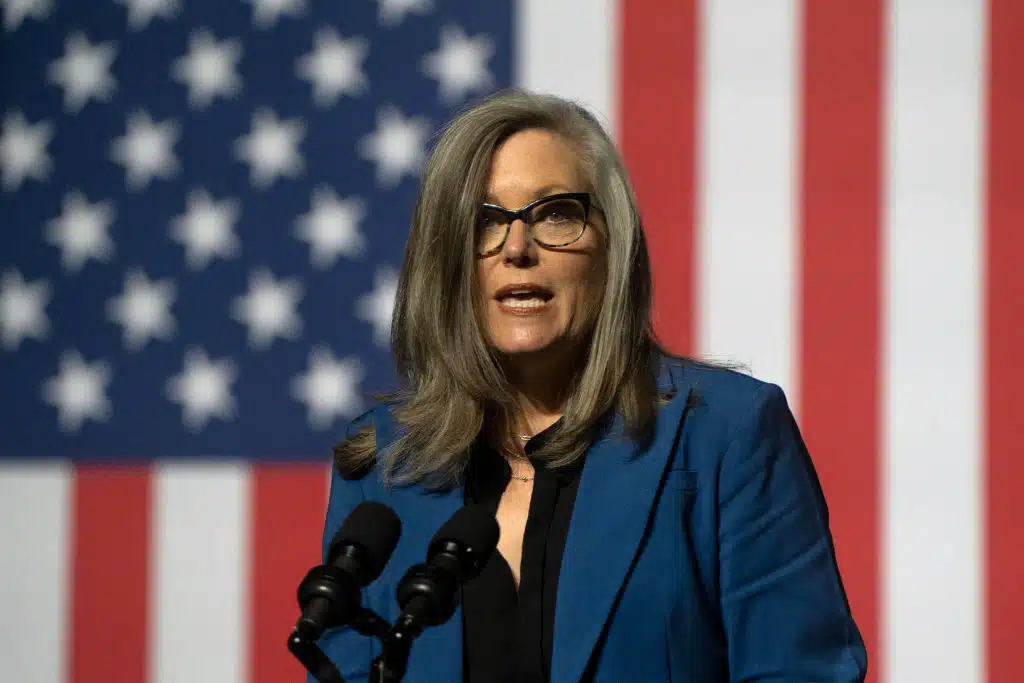
Arizona Governor Katie Hobbs, a Democrat seeking reelection this year, is under fire after vetoing legislation that would have blocked Chinese entities from acquiring land near sensitive sites such as military bases, Fox News reports.
The bill, S.B. 1109, was designed to prevent the Chinese government from holding significant stakes—30% or more—in Arizona properties located close to strategic locations. Supporters argued that this measure was necessary to protect national security, citing concerns over foreign investment near military installations like Luke Air Force Base, where U.S. fighter pilots are trained.
State Senate Majority Leader Janae Shamp criticized Hobbs’ decision, calling the veto “utterly insane” and accusing the governor of hindering efforts to protect Arizona residents from potential threats. Shamp called the veto “politically motivated.”
Michael Lucci, CEO of the conservative group State Armor Action whose mission is “to develop and enact state-level solutions to global security threats,” echoed these concerns. He claimed that Hobbs’ veto effectively invites the Chinese Communist Party (CCP) to purchase land near critical infrastructure, including the Palo Verde nuclear power plant and the expanding Taiwan Semiconductor manufacturing site. Lucci argued that allowing such purchases poses a clear security risk, especially given recent global events where proximity to military assets has led to vulnerabilities.
“Lucci pointed to Ukraine’s recent drone attacks that destroyed significant numbers of Russian military aircraft, noting that ‘proximity produces peril in asymmetric warfare,’” according to Fox News.
Governor Hobbs, however, defended her decision, stating that the bill would not have effectively countered espionage and lacked clear guidelines for enforcement. She warned that the legislation’s vague criteria could lead to arbitrary application.
The bill had undergone bipartisan revisions to address worries about potential discrimination in land sales, narrowing its scope to target only entities tied to the Chinese government and its subsidiaries.
Arizona is not alone in grappling with this issue. Across the United States, at least 27 states are considering a total of 84 bills to restrict foreign property ownership, according to the nonprofit Committee of 100, which focuses on China. Congress is also reviewing seven federal bills on the matter. So far, 22 states have enacted laws to limit foreign land purchases, with 17 of those becoming law in 2024.
The Arizona legislature could still override Hobbs’ veto, keeping the debate over foreign land ownership and national security alive in the state.
