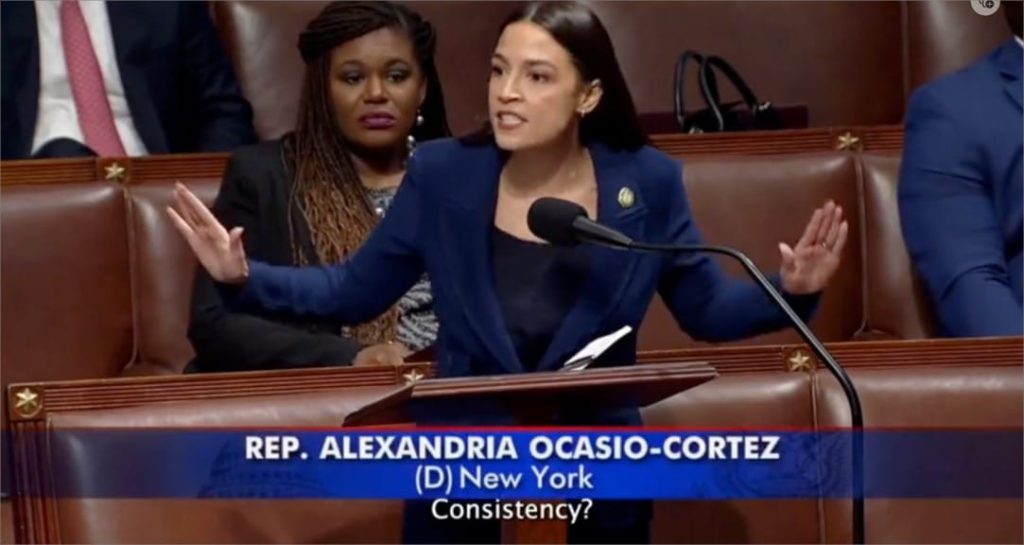
Rep. Alexandria Ocasio-Cortez’s (D-N.Y.) faceplant at the Munich Security Conference wasn’t her only stumble this week.
In Munich, she demonstrated that she is profoundly ignorant of U.S. foreign policy, history and even geography — despite being an international relations major! As much as this showed she is not equipped to run for higher office, the more important revelation was her doubling-down on her central political thesis — the argument that energizes the progressive cabal in charge of the Democratic Party.
What do Bernie Sanders, Zohran Mamdani and the other leftist Democrats have in common? What do they rail about? Growing income inequality, and the threat to democracy posed by that development.
It turns out that their argument isn’t true. In a major cover story, the left-leaning Economist magazine reports that income inequality is not growing; in fact, in most developed countries, it is shrinking. Why? Because across the West, including in the U.S., tax curves are steepening and the welfare state is expanding.
After embarrassing herself last week on the world stage, Ocasio-Cortez called the ever-accommodating New York Times to whine that criticism of her inability to articulate basic U.S. foreign policy issues had obscured her big message, that “runaway inequality … is fueling far-right populist movements.” Ocasio-Cortez suggested that critiques of her claim that Venezuela is below the equator, for instance, were purposefully meant to “distract from the substance of what I am saying.”
She is right that critics should focus on the substance of what she and other leading lights of the progressive left are saying about income inequality. Because what they’re saying is factually wrong.
As the Economist noted, there is compelling evidence that even as the rich have gotten richer over the last few decades, there has also been “a much less noticed, countervailing trend: as pre-tax incomes have become more unequal, tax codes have become more progressive.”
That means that even though the share of income earned by the top 1 percent is bigger, so is its share of the tax burden. After taxes, the rich are not grabbing a bigger piece of the pie. So when Mamdani and Elizabeth Warren call to make the rich pay their “fair share,” they ignore that evolving tax codes, including in the U.S., are already seeing to that.
This is not an arcane or unimportant argument. Democrats have been seizing on supposedly rising income inequality for years to bolster their demands for an ever-increasing welfare state funded by higher taxes. They perpetually claim that any Republican-led effort to lower taxes benefits only the wealthy.
But that is not true. Analysis of tax changes included in the One Big, Beautiful Bill, for instance, shows that middle-class families will be the biggest beneficiaries, whereas the burden shouldered by the top 10 percent of earners in 2027 will increase from 70 percent to 78 percent of all income tax revenue collected.
Even the left-leaning Tax Policy Center’s analysis of the tax new changes shows the highest-earning Americans paying an increased share of the nation’s taxes. The same phenomenon occurred with the tax bill passed during President Trump’s first term — the share of taxes paid by the highest income groups went up, not down.
What none of these arguments capture, of course, are the ancillary benefits of lower taxes. Coupled with the lighter regulations promoted by the president, a reduced tax burden confers benefits on everyone in the form of higher growth and better wages. Today, even as Democrats continue to pillory the Big Beautiful Bill and claim that the Trump agenda is only pitched to the wealthy, the economy is growing and real wages are increasing.
The Bureau of Labor Statistics reports that “real average weekly earnings increased 0.5 percent” in January and that the country experienced a 2.2 percent increase over the past year in real average weekly earnings. In contrast, under former President Biden, real wages fell 1.4 percent, thanks mainly to high inflation. Prices rose by 21 percent during the Biden years, the source of ongoing “affordability” issues.
The Economist argues that “governments are increasingly soaking the rich,” but that’s not the way progressive Democrats see it. They look to Thomas Piketty’s “Capital in the Twenty-First Century,” which argued that high income and wealth inequality will inexorably undermine democracy, and require robbing the biggest piggybanks to satisfy the needs of the poor.
But that is not what is happening today. The Economist reports, in the U.S., “the 1 percent paid 40 percent of income tax in 2022, up from 33 percent in 2001.” And the same phenomenon has taken place most G7 countries.
Ocasio-Cortez spent time in Europe talking up a wealth tax — the ultimate progressive weapon. She is apparently unaware that many European countries have tried implementing wealth taxes, only to roll them back after disastrous results. France slapped the rich with a wealth tax in 1982, which was expected to generate substantial revenues. It flopped, raising only 2 percent of GDP on average and driving over 60,000 millionaires out of the country. Subsequent analysis concluded that the tax actually lost money for France.
Germany and Sweden had nearly identical experiences.
Maybe next time Ocasio-Cortez ventures abroad, she might want to do her homework. She might also, as she campaigns for higher taxes in the U.S., consider that the states with the heaviest tax burdens, like her own New York, are losing high-earning taxpayers and businesses, hurting precisely the people she pretends to care about most.
This article originally appeared on TheHill.com