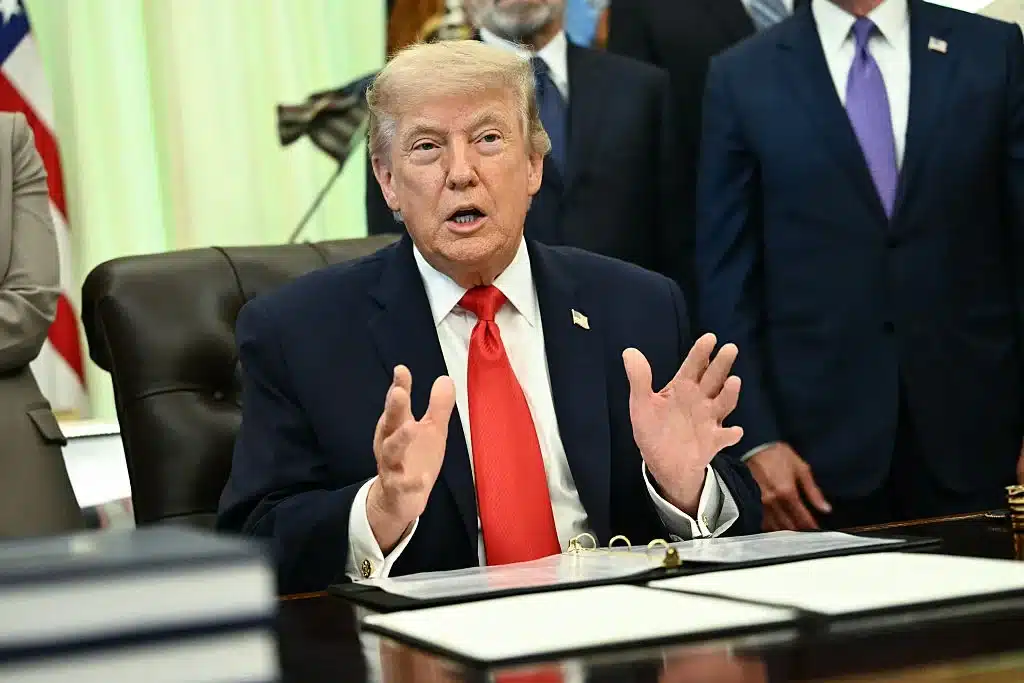
Kathy Hochul recently attacked President Trump for driving up energy prices for New Yorkers. The governor warned that Trump’s trade dispute with Canada could lead to higher costs for New York residents after Ontario Premier Doug Ford threatened to retaliate by cutting electricity exports to the United States.
“There’s exactly one person to blame when electricity bills go up: Donald Trump,” Hochul said.
One might wonder why New Yorkers depend on Canada to supply their electricity when the United States is the world’s biggest oil producer, and our country’s natural gas output, the largest feedstock for electricity production, has expanded by nearly 50 percent over the past decade.
As the New York governor well knows, it is the war waged by herself and her predecessor, Andrew Cuomo, against those same fossil fuels (which supply some 60 percent of the nation’s electricity) that have spiked electricity prices. Also boosting costs was the former governor’s boneheaded decision to shut down the Indian Point nuclear power station. Those two disastrous policies combined to push residential electricity prices in New York fully 62 percent above the national average, the third highest in the nation. Cuomo and Hochul traded affordable electricity for votes and donations from climate zealots, in the process costing residents of the Empire State billions of dollars.
Yes, oil prices have climbed 25 percent over the past year, in large part because of the war with Iran. But that jump pales in significance to New York formally banning fracking in 2015, thus depriving residents not only of jobs and income but also plentiful natural gas. It is no surprise that electricity prices in Pennsylvania, which allowed fracking of the Marcellus shale in that state, are about 30 percent lower than in Hochul’s New York.
We know the Cuomo-Hochul assault on fossil fuels is damaging New York because the current administration has moved to postpone some of the draconian requirements of the state’s climate laws. New York’s 2019 Climate Leadership and Community Protection Act, one of the strictest in the nation, called to cut greenhouse gas emissions by 40 percent compared to 1990 levels, and 85 percent by 2050. It also required the state to transition to 100 percent zero-emission electricity by 2040.
Integral to the bill was a cap-and-trade program that Hochul argued in a memo would impose costs of more than $4,000 annually per family in 2031. As Politico noted, Hochul’s waffling “is one of the clearest signs yet that Democrats are recalibrating their climate agenda as the party increasingly prioritizes affordability ahead of the midterms.”
But even Hochul cannot fool all the people all of the time. New York State residents, concerned about affordability, will no longer accept her preposterous kowtowing to the radical climate activists clamoring, apparently, to eat by candlelight in unheated homes.
Of course, New York is not the only Democrat-run state sacrificing its citizens on the altar of climate change. Blue states in general have higher energy costs than red states, according to data compiled by researcher Sarah Montalbano and published by the Institute for Energy Research.
As they note, “in 2011, average all-sector electricity prices in Blue states were about 3.6 cents per kilowatt-hour (kWh) higher than in Red states, or 44 percent higher. By 2025, Blue state electricity prices were 6.33 cents per kWh higher than those in Red states, a 61 percent difference.”
The study indicates that the growing gap between blue and red states’ electricity prices is driven by policy choices; if regional or geographic factors were to blame, the cost difference would likely remain constant.
The group details especially what it calls the “explosion in electricity prices in some of the country’s most notorious blue-state policy regions, such as New England and California,” noting that the Golden State “has become a poster child for the ballooning costs of an electric grid that is increasingly reliant on wind, solar, and battery storage.” New England, for its part, has taken the lead in shunning abundant and relatively clean natural gas.
The penalty for living in climate-obsessed California or New England is severe; since 2011, the data shows, electricity prices in those two regions have soared nearly four times faster than the national average (excluding them). Specifically, electricity rates in California and New England have jumped by 90 percent, compared to just 23 percent in the rest of the country.
New York was not the first high-cost energy state to walk back injurious climate legislation. Connecticut earned that distinction in June 2025, when it took the lead in rescinding an onerous renewable energy mandate. The state reduced its renewable energy target from 40 percent to 29 percent for 2030, and from 32 percent to 25 percent for 2026. The changes are expected to save somewhere around $60 million per year starting in 2026, lowering residential electric bills by around 14 percent.
All across the country, and indeed all across the developed world, policymakers are reassessing the costs of climate policies. Trump led the charge, dismantling much of former President Biden’s green initiatives, much to the disgust of European leaders who have been in the vanguard of erecting costly climate hurdles that have slowed their growth and crippled their industries.
As The Wall Street Journal recently reported, “The European Union has proposed to relax its landmark carbon-pricing system, and allow automakers to sell gasoline-burning cars for longer.” They also note that the U.K. is considering pursuing reopening North Sea acreage to new oil exploration and may dump its support for elective vehicles. At the same time, the Journal reports, “Canada dismantled an unpopular carbon tax and is backing new oil-and-gas infrastructure.”
Elected officials everywhere are under pressure to bring prices down; dumping costly climate laws that outlaw the use of abundant and relatively cheap fossil fuels is an attractive fix.
Read Liz Peek’s full column on The Hill here.
